

Problem statement
The human face contains substantial information about both genetic and environmental factors related to the identity of a person, which is used in a biometric system. In this context, facial recognition from DNA refers to a biometric system that aims to identify or verify DNA-related traits against facial images with a known identity. In other words, such a system intends to match the DNA of an unidentified individual to the facial characteristics of a person with a known identity. A classic example in forensics is the prediction of the appearance of an unknown person from the biological material found at a crime scene and then matching it with the facial characteristics of a list of suspects.
Methodology
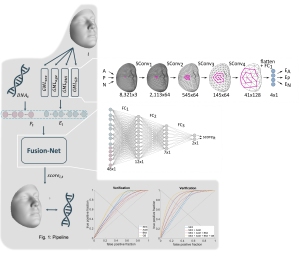
The general scheme of the proposed face-to-DNA matching framework is shown below. The goal is to match the 3D face of an individual
i to a set of properties Pt that are extracted from unidentified genetic material DNAt.First, a set of embeddings are extracted using our Geometric
Metric Learner (GML) blocks for each property. These blocks are implemented using spiral convolutional operators and a novel equidistant mesh down-sampling and are trained by triplet loss function. Next, these embeddings are concatenated (Ei), combined with Pt and passed through the Fusion-Net to produce a matching score(i,t). Finally, this score can be evaluated in a verification scenario, in order to either verify whether individual ?’s characteristics match with DNAt.
Conclusion
This paper introduces a non-linear neural based alternative to the state-of-the-art face-to-DNA biometric system using spiral convolutional networks. The proposed pipeline consists of two major building blocks, GML and Fusion-Net, each contributing to the boosted performance compared to the baseline. The GML block employs spiral convolutional operators for metric learning, in contrast to the already existing generative models [36]. On top of that, we use a novel sampling method to obtain several resolutions. To learn a low dimensional semantic representation of the facial meshes, the designed spiral encoders are trained by the triplet loss function. We rebuilt the triplet selection strategy to cope with continuous properties. The second step of our proposed pipeline deploys Fusion-Net, a non-linear biometric fuser which avoids obtaining scores prior to the fusing. The performance of the final multi-biometric system trained with all properties indicates that the combination of GML and Fusion-Net improves the verification accuracy. We plan to further improve the performance by modifying the architecture of the Fusion-Net, in order to facilitate transfer learning between individual and cumulative runs. Moreover, developing a part-based GML for computing local embeddings is another foreseen extension to the current neural-based system.
citation:
S. S. Mahdi & N.Nauwelaers et al., “3D Facial Matching by Spiral Convolutional Metric Learning and a Biometric Fusion-Net of Demographic Properties,” in ICPR 2020 25th International Conference on Pattern Recognition, 2021, pp. 1757–1764